a.) The disaster I chose to learn more about is wildfires. Growing up in Southern California, I did not experience snow days; rather, I experienced smoke days. I remember in middle school I did not have to go to school because the smoke in the air from a nearby wildfire was too hazardous. This is an increasing problem as more and more communities have a wildland-urban interface, increasing the odds of smoke exposure. It has been noted that smoke from a wildfire can extend up to 1,000 miles. In addition to wildfires, prescribed fires are also a source for hazardous smoke exposure. Prescribed fires are commonly used to preclude out-of-control wildfires. Over the past decade, U.S agencies burn an average of 2.2 million acres each year.
Smoke from wildfire emit a number of particulate matter, nitrogen oxides, trace minerals, polycyclic aromatic hydrocarbons, carbon monoxide, and carbon dioxide. The adverse health effects of smoke exposure are eye irritation, fatigue, headaches, dizziness and stress. Notable populations that are most vulnerable to smoke are children, the elderly, pregnant women, and individuals with chronic respiratory conditions.
Despite the known adverse effects of smoke exposure, there is limited data of the health effects of smoke exposure due to the fact that fires are often short lived. Public health officials require more information to fully understand the mechanism of which smoke exposure cause detrimental health effects.
b.) In Temecula, the city offers CERT (Community Emergency Response Teams) training for those willing to commit 20 hours of training. The training is cost-free. It is designed to teach citizens to provide basic medical aid, search for and rescue victims safely and organize themselves to help mitigate disasters. Those who successfully complete the practical exercise with training in fire suppression, search and rescue, cribbing, and triage receive a certificate of completion.
Sunday, April 30, 2017

Thursday, April 27, 2017
M10.1 Occupational Health and Safety
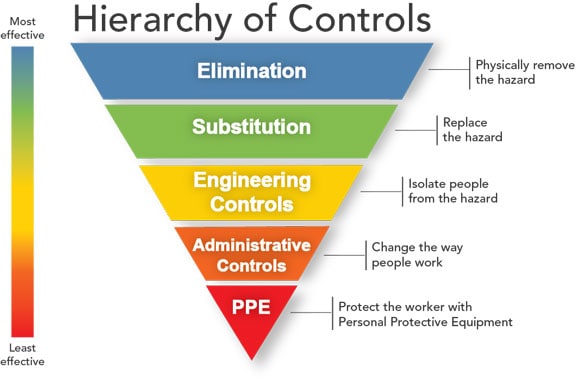
The workplace I chose to focus on is my cousin who manages his parents vineyard and his own organic farm out in the local wine country. He is exposed to a number of ergonomic issues as well as chemical issues. I met up with my cousin a week ago and asked him how his day was. He said he was managing his parents grapes and just finished spraying pesticides.
Considering the industrial hierarchy of controls, elimination of the use of arsenic would be the most effective method; however, it is not likely considering the damage pest can have on their products. With that said, the most feasible method to with my cousins arsenic exposure would be to either substitute the chemical with a less dangerous chemical or to invest in a PPE, specifically a haz mat suit.
2) What might be the barriers to workers exercising their rights to a healthy and safe workplace?
There are a number of barrier that would deter workers from exercising their right to a healthy and safe work environment. In certain sectors, such as agriculture, workers may be worried about their immigration status. For the most part the biggest and most common barrier is reprisals and/or being fired. Depending on the health issue claim and the repercussions that arise, employers may retaliate which may cost the employee his or her job.
Tuesday, April 18, 2017
M12.9 Climate Change
1) What do you personally find most troubling about climate change?
After learning about climate change throughout this module, I find that food waste and trash are the most troubling issues contributing to climate change. The fact that 40% of fresh food will end up in landfills is upsetting, especially when there are individuals in this country that struggle to put food on the table. These foods and trash end up in landfills to decompose and emit gross amounts of methane in the atmosphere. In addition to the methane, the carbon foot print that it takes to produce the 40% of food waste also seems like an unnecessary waste of resources.
2) As a public health professional, what do you think needs the greatest attention right now?
Besides our reliance on fossil fuels, I believe that food waste needs our greatest attention right now because eliminating food waste seems like an attainable goal for individuals. With a national effort to shop local and produce their own foods, our reliance on mass production of food will decrease and, in turn, food waste will decrease as well. As a public health professional, I would strive to have a national health campaign to disseminate the benefits of shopping local and organic; and partner with small scale farmers to teach backyard farming techniques. This effort would ensure a decrease in our individual demands on foods with a large carbon foot print.
3) If you were visiting with a long-lost relative who had never heard about climate change, how would you describe it and its attendant human health and ecological threats?
If I were to explain climate change to a long lost relative, I would keep it simple. I would explain to him/her that there is a global change in climate due to the amount of greenhouse gases that are emitted into the atmosphere. I would explain that these greenhouse gases create a blanket in our atmosphere that capture heat on our planet, resulting in extreme changes in climate. I then would explain that these man-induced changes to our environment are not natural and force untoward changes in our environment that affect many ecological regions and behaviors.
After learning about climate change throughout this module, I find that food waste and trash are the most troubling issues contributing to climate change. The fact that 40% of fresh food will end up in landfills is upsetting, especially when there are individuals in this country that struggle to put food on the table. These foods and trash end up in landfills to decompose and emit gross amounts of methane in the atmosphere. In addition to the methane, the carbon foot print that it takes to produce the 40% of food waste also seems like an unnecessary waste of resources.
2) As a public health professional, what do you think needs the greatest attention right now?
Besides our reliance on fossil fuels, I believe that food waste needs our greatest attention right now because eliminating food waste seems like an attainable goal for individuals. With a national effort to shop local and produce their own foods, our reliance on mass production of food will decrease and, in turn, food waste will decrease as well. As a public health professional, I would strive to have a national health campaign to disseminate the benefits of shopping local and organic; and partner with small scale farmers to teach backyard farming techniques. This effort would ensure a decrease in our individual demands on foods with a large carbon foot print.
3) If you were visiting with a long-lost relative who had never heard about climate change, how would you describe it and its attendant human health and ecological threats?
If I were to explain climate change to a long lost relative, I would keep it simple. I would explain to him/her that there is a global change in climate due to the amount of greenhouse gases that are emitted into the atmosphere. I would explain that these greenhouse gases create a blanket in our atmosphere that capture heat on our planet, resulting in extreme changes in climate. I then would explain that these man-induced changes to our environment are not natural and force untoward changes in our environment that affect many ecological regions and behaviors.
Monday, April 10, 2017
M11.5 Zero Waste Life
After watching the Zero Waste video, I noticed how many of the things I use every day that add up to waste. My food packaging and the products I use can all be substituted with farmers market foods and products I can somehow learn to make myself - if she can do it, why not anyone else? I started taking mental notes of things I can change. I could start to bring my own jars and bags to purchase groceries in bulk, and I could sacrifice the products that were unnecessary that I didn't know how to make. Also, if I needed a new TV or table for example, I could go to a second-hand store to purchase these items, thus saving money and preventing those items from being wasted. All in all, it was a very informative and thought-provoking video.
Monday, April 3, 2017
M10.2 MSDS and ToxNet
As a clinical research coordinator, I deal with subject that require regular blood draws. For this reason, the Material Safety Data Sheet I chose is for the product below:
Were there any discrepancies regarding the potential health effects noted in the MSDS?
After searching EDTA in HSDB on the TOXNET website, I noticed there were no discrepancies between what was on the MSDS and website.
https://toxnet.nlm.nih.gov/cgi-bin/sis/search2/f?./temp/~XN54fj:1
BD Vacutainer Brand Tube with Dispotassium EDTA. This is a blood collection tube with Dispotassium EDTA inside.
What are the health risks associated with this chemical?
As stated in the MSDS, this product may cause eye and skin irritation. Inhalation causes respiratory tract irritation. Ingestion causes gastrointestinal irritation and nausea, vomiting and diarrhea.
Is the chemical a carcinogen?
The chemical is not listed as a carcinogenic.
What personal protective equipment or special precautions should be taken when working with this chemical?
After inhalation: move the exposed person to fresh air.
After skin contact: immediately flush skin with plenty of soap and water for at least 15 minutes.
After eye contact: immediately flush with plenty of water for at least 15 minutes.
After swallowing: immediately give large amounts of water. Get medical attention.
Information for doctor: show this label (MSDS).
If this is a chemical found in your workplace, what training/education were you given about any risks associated with this chemical?
This chemical is commonly found in the workplace, although sealed shut in a blood collection tube. I was trained how to properly use and dispose of the product but was not aware of the MSDS of this product.
Before learning about MSDS's, I did not know about how readily available occupational safety and health information was regarding certain products and chemicals I work with on a daily basis. I found several MSDS's in a lab manual. Most are easy to read and have all the information one would need to know if they are exposed to the chemical. I believe it is the employers duty to ensure that all employees are made aware of these documents in an effort to ensure everyone in the workplace is safe from any type of chemical exposure.
Were there any discrepancies regarding the potential health effects noted in the MSDS?
After searching EDTA in HSDB on the TOXNET website, I noticed there were no discrepancies between what was on the MSDS and website.
https://toxnet.nlm.nih.gov/cgi-bin/sis/search2/f?./temp/~XN54fj:1
M10.5 Occupational Safety and Health Organization
The National Institute for Occupational Safety and Health (NIOSH) is a research organization that is focused on studying workers safety and health, and to educate employers and workers to create safe and healthy work spaces. This agency is associated with the Center of Disease Control and Prevention within the US Department of Health and Human Services. Their mission is "to develop new knowledge in the field of occupational safety and health and to transfer that knowledge into practice," (https://www.cdc.gov/niosh/about/).
NIOSH provides a variety of occupational safety and health information for all sectors of work. They provide research-driven evidence of ways to ensure employers and workers are safe in their work space. They provide information of all occupational health topics from arsenic to the Zika Virus.
In terms of topics that relate to my work, I chose the topics bicycle saddles and reproductive health (because I commute to work often) and how to prevent violence on the job (because I work with unpredictable populations such as schizophrenics). It was interesting to learn all about the information provided. NIOSH goes into detail on every topic to ensure that employers and workers are safe and healthy on the job. I look forward to using NIOSH throughout my career and will share with website with my colleagues.
Subscribe to:
Posts (Atom)